11/09/2026
Sabancı University hosted the Third Workshop on Quantum Technologies and Computing (SUQUNET) on September 4, 2026, bringing together leading international researchers, Sabancı University faculty, students, and representatives from technology-intensive industries to explore the rapidly evolving landscape of quantum science and technologies.

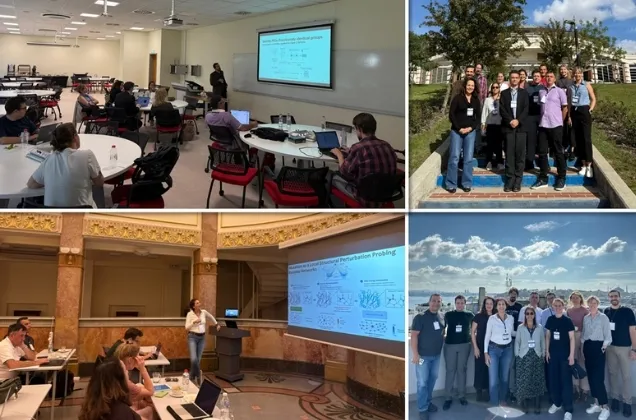
The workshop featured 10 invited expert speakers from leading universities and research institutions around the world and attracted more than 100 participants. Alongside academics, researchers, and students, the event welcomed professionals from strategic sectors including aerospace, defense, finance, and healthcare, creating a diverse forum for scientific exchange and dialogue on the emerging applications of quantum technologies.

The workshop opened with remarks by Prof. Yusuf Leblebici, President of Sabancı University, who joined the event online. Prof. Mehmet Yıldız, Vice President for Research and Innovation, then highlighted the strategic importance of quantum technologies for the future of science, technology, and industry, as well as Sabancı University’s growing research capabilities in this field. The scientific program was introduced by Prof. Zafer Gedik of the Faculty of Engineering and Natural Sciences.

From Quantum Communication to Next-Generation Materials
The scientific program was organized around four complementary themes spanning key layers of the quantum technology landscape: Quantum Communication Technologies, Quantum Computing and Optimization, Quantum Photonics and Micro/Nano Systems, and Next-Generation Quantum Materials.

The opening session on Quantum Communication Technologies featured Daniel Oi from the University of Strathclyde and Mustafa Gündoğan from Humboldt-Universität zu Berlin, addressing developments relevant to quantum communication and future quantum networks.


The Quantum Computing and Optimization session brought together Esra Yeniaras from Copenhagen School of Business and Technology, Davide Venturelli from USRA, and Alejandro Montañez-Barrera from Forschungszentrum Jülich. Their contributions explored emerging directions in quantum computation and optimization, including the opportunities and challenges associated with translating quantum algorithms into practical applications.

In the afternoon, Mustafa Yavuz, Eihab Abdel-Rahman from the University of Waterloo, and Amir Faroukh-Payam from Ulster University contributed to the session on Quantum Photonics and Micro/Nano Systems, highlighting research at the intersection of photonics, sensing, resonators, and micro- and nanoscale technologies.
The scientific sessions concluded with Next-Generation Quantum Materials, featuring Lijie Li from Swansea University and Sırrı Batuhan Kalkan from the University of Göttingen. The session explored materials and low-dimensional systems that could underpin future generations of quantum devices and technologies.
A Growing Quantum Research Community at Sabancı University
The workshop also highlighted the breadth of the quantum science and technology community emerging at Sabancı University, where expertise from different disciplines is increasingly converging around quantum research.
The University’s community in this field includes Alhun Aydın, Burç Mısırlıoğlu, Cem Güneri, Emre Erdem, Erkay Savaş, Ferruh Özbudak, Göktuğ Karpat, İnanç Adagideli, İsmet İnönü Kaya, Mehmet Yıldız, Mustafa Yavuz, Özlem Salehi Köken, Serkan Ateş, Yılmaz Şimşek and Zafer Gedik.
Collectively, their research spans areas including quantum computing, quantum communication, quantum sensing, photonics, advanced and quantum materials, nanoelectronics, cryptography, and micro/nano systems. The breadth of this expertise enables Sabancı University to approach quantum technologies from a multidisciplinary perspective, connecting fundamental science with materials, devices, algorithms, communication, sensing, and security.
SUQUNET provides a natural meeting point for these capabilities, linking the University’s research community with international expertise and opening new channels for scientific collaboration.
Bringing Academia, Industry, and Emerging Talent Together
A defining feature of this year’s SUQUNET was the diversity of its participants. With more than 100 attendees, the workshop brought academics and researchers into direct dialogue with students and professionals from aerospace, defense, finance, healthcare, and other technology-driven sectors.
This breadth of participation fostered a vibrant exchange across disciplines and sectors, connecting advances in quantum science with emerging technological and industrial opportunities. Discussions continued beyond the formal presentations, providing space for participants to identify shared interests, explore new research questions, and consider opportunities for international and academia–industry collaboration.
The interaction among invited international experts, Sabancı University researchers, industry representatives, and students was one of the highlights of the workshop. Bringing these communities into the same environment created an exceptional setting for new connections and future initiatives, while demonstrating the value of building bridges between fundamental research, technology development, and prospective applications.
The strong engagement of students and young researchers added another important dimension. Direct access to international scientists, Sabancı University faculty, and industry professionals offered young researchers an opportunity to engage with current developments in quantum technologies while gaining a broader perspective on the scientific and technological challenges that will shape the field in the years ahead.

Building a Connected Quantum Ecosystem
Now in its third edition, SUQUNET reflects an ambition that extends beyond the exchange of scientific results. The workshop seeks to connect the different communities required for quantum technologies to progress — scientists, engineers, students, technology developers, and industries with the potential to adopt and shape future quantum applications.
This year’s gathering demonstrated that vision in practice. Ten invited expert speakers from leading institutions around the world, Sabancı University’s multidisciplinary quantum research community, more than 100 participants, and representatives from strategic sectors including aerospace, defense, finance, and healthcare came together around a shared interest in the future of quantum technologies.

The resulting dialogue connected fundamental research with technological challenges, emerging applications, and human capital. It also reinforced the importance of collaboration across disciplines, institutions, and sectors as quantum technologies move from scientific discovery toward increasingly sophisticated systems and real-world applications.
Following four scientific sessions and a full day of discussions and networking, the Third SUQUNET Workshop concluded with closing remarks and an overall evaluation.
Building on the momentum generated by SUQUNET, Sabancı University aims to further strengthen international research collaborations, foster academia–industry partnerships, develop new research initiatives, and contribute to the education of the next generation of quantum scientists and engineers. Through these efforts, the University seeks to play an active role in advancing Türkiye’s capabilities in quantum science and technologies while remaining strongly connected to the international quantum research community.